Woman Who Let People Do Whatever They Wanted for Art
In 1974, Marina Abramović did a terrifying experiment. At a gallery in her native Belgrade, Serbia, she laid out 72 items on a trestle table and invited the public to use them on her in whatever mode they saw fit. Some of the items were benign; a feather boa, some olive oil, roses. Others were non. "I had a pistol with bullets in it, my dear. I was ready to dice." At the end of vi hours, she walked away, dripping with blood and tears, but live. "How lucky I am," she says in her even so heavy emphasis, and laughs.
This June, Abramović, who at 67 sometimes refers to herself every bit "the grandmother of performance art", will open an exhibition at the Serpentine Gallery in London, her first original performative testify in the U.k., in which, she says, she will be more than daring and more than vulnerable than she was both in Belgrade and at MoMA in New York, four years agone. Then, Abramović saturday in a chair in the gallery for eight hours a day, while visitors streamed in and, 1 by i, occupied the chair opposite her. Some wept; others laughed. At least one took off all her apparel and had to be removed by security. For three months, Abramovic sat there, impassive, during which fourth dimension The Artist is Present drew tape crowds to the gallery and became one of the about famous and controversial pieces of operation fine art ever staged. Fob News got very cross near what it all meant and referred to her every bit "some Yugoslavian-built-in provocateur," while a curator at the Whitney Gallery called her "one of the most significant artists of the second half of the 20th century." For her part, Abramović sat. And sat. And sabbatum.
Now hither she is on a dull morning in a studio in Brooklyn, dressed head to toe in Givenchy, her favourite designer, and nibbling on what looks like a pellet of astronaut food. For her Serpentine evidence, Abramović has to be fit, both mentally and physically. She is on a strict diet, and will shortly be leaving for Brazil to come across up with some sort of shamanic adviser. She'll need it; the London show, which is called 512 Hours for the elapsing of time she volition spend in the gallery, will remove fifty-fifty the few shreds of construction the MoMA bear witness clung to. No chair this time, and no table. Instead, all twenty-four hours every day from 11 June to 25 August, Abramović volition wander around the gallery where, afterwards being asked to shed their coats, watches and all their devices, visitors will be invited to come in and peer at her. "It'south the public and me and nothing else," she says. "I took the objects away. But the encounter ..." She smiles. "I've never done anything as radical every bit this. This is every bit immaterial as you lot can become."
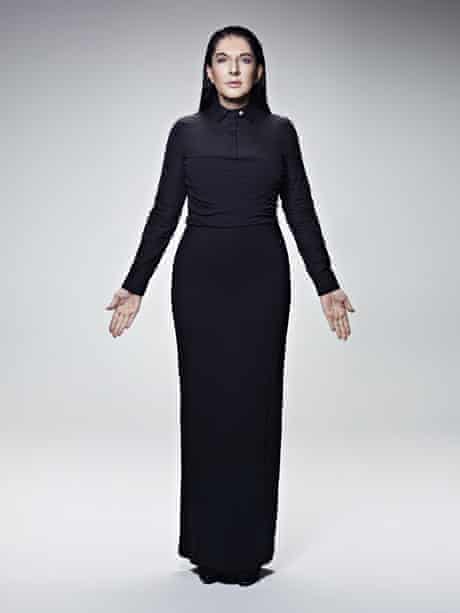
When performance fine art is bad, information technology is worse than almost annihilation and even the skilful stuff is vulnerable to ridicule. It looks like naught on paper; a adult female wanders effectually a gallery – where's the artistry in that? Those tempted to scoff should watch the HBO documentary on Abramović'due south MoMA show, to see how an unpromising premise turned, in reality, into an extraordinarily moving series of encounters. Since her early days in Serbia, Abramović has put herself under extreme concrete and mental duress to jolt viewers out of ordinary patterns of thinking. "The medium is the body," she says, which is what all performance artists say, simply when Abramović cuts herself with a pocketknife, or slams her body into a wall, it is washed with such purity of purpose the viewer is lifted temporarily out of themselves. It is the opposite of sensationalism or exhibitionism – a gesture of cocky-erasure in the Romantic sense – and to sit nevertheless for three months, inviting connectedness with strangers is something that, in the context of the harried and distracted lives we live, makes perfect sense. No wonder people cried.
"You accept to be in a land in which you are completely secure about your ability create this kind of charismatic space," she says, and is currently lying awake at dark "in total panic" about doing it once again at the Serpentine. "That's actually hell."
It is but recently that any of this has hit the mainstream, and Abramović as rock star – as well as knocking effectually with Lady Gaga, who she helped develop strategies to stop smoking (such as counting grains of rice), she is on the embrace of mode magazines and her Maria Callas-esque profile on the way to becoming iconic – is the fruit of a 40-yr struggle. For decades, Abramović was poor and across the art world, obscure, living out of a van for the best part of x years with her then life-partner, Uwe Laysiepen, a High german creative person who performed under the proper name Ulay and with whom she drove around Europe, collaborating on her seminal work of the 70s. (The van, incidentally, was tracked down and displayed at the MoMA retrospective, which caused Abramović to completely freak out. "That van," she says, and shudders).
When she and Ulay broke up, it was in grand fashion: they turned the death of their relationship into a piece called The Lovers (1988), in which they walked towards each other from two sides of the Swell Wall of Cathay – 2,500km each, over the course of several months – meeting in the center "to say goodbye". If that's not devotion to ane's fine art, I don't know what is.
Abramović came out of a tough background. Her parents had close ties to the post-war communist regime of what was so Yugoslavia and her female parent raised Abramović in a habitation run more like a boot camp than a family. In 2011, she turned what amounted to an abusive upbringing into a stage production called the Life and Death of Marina Abramović, co-starring Willem Dafoe and Antony Hegarty of Antony and the Johnsons, and in which she played both herself and her mother. "Every rehearsal I cried from the beginning to the end," she says. "Then ane day Bobby [the manager] said, enough of this bullshit crying. The public has to cry, non yous. Later iii years of touring in Europe, I was free. All these stories don't impact me any more than. An incredible feeling."
This was subsequently years of critiquing the repressive nature of both her family and her country through performance art. In her slice The Lips of Thomas (1975), she carved a five-pointed communist star into her ain abdomen, a monstrously sly upwards yours to the regime and cribbing of brutality for her own purposes. In other gallery settings, she and Ulay slammed into each other, shrieked in each other's faces, or sat staring at each other for interminable lengths of time to test, and conquer, the boundaries of what is endurable. It was thrilling, shocking, above all, moral and sailing ever in the face of accusations of meaninglessness. The smashing danger with this sort of art, of form, is that pain is mistaken for meaning.
"In the outset at that place were only masochists doing this shit and it was ridiculous. They needed to get to a psychiatric clinic," she nods. "Information technology'south more complicated to explain. In every culture, [there are those] shamans or medicine men who endured incredible physical pain, because information technology's a door opening to the subconsciousness. And the way nosotros tin actually control the pain – it'southward how to control everything. This is the key."
The feel at MoMA would take turned nearly people mad – sitting still for that length of time, neither speaking nor moving. (There was a concealed hole in her chair, with a sleeping room pot fitted below information technology, so she didn't accept to get up to go to the loo). Abramović was not daydreaming. The whole point of the practice, she says, was to be fully present, concentrating on connecting with whoever came in to sit down reverse her, and "I never saw so much pain in my life." The huge number of people who wept, she thinks, was brought on past this staged state of affairs in which "in that location is nowhere to get except in yourself. Information technology was shocking. Merely how uncomplicated it was."
Earlier the show opened, both Abramović and MoMA half worried that no one would turn up. As the thing took off, celebrities started to drift in to sit reverse her, including, inevitably, James Franco – and then Ulay came. Abramović broke protocol and reached out to grasp his hands across the table. Anybody cheered. "I absolutely didn't look he'd come to sit. The moment he sat – and everyone got very sentimental almost it, because they were projecting their own relationships on to united states of america – just information technology was so incredibly difficult. It was the simply time I bankrupt the rules."
What is her compulsion to move towards, rather than away from the things that most terrify her?
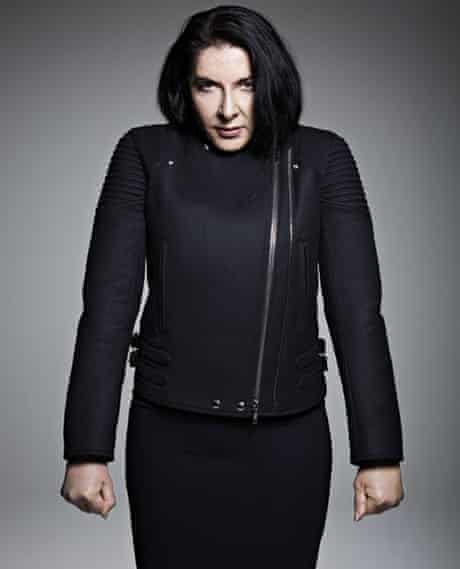
"From a very early time, I understood that I only acquire from things I don't similar. If you do things you similar, you lot but do the same shit. You always autumn in love with the wrong guy. Because in that location's no alter. Information technology's so easy to do things y'all like. But then, the thing is, when y'all're afraid of something, face it, go for information technology. Y'all become a meliorate homo."
What's the cost?
"Ah, a big 1. Lots of loneliness, my dear. If y'all're a woman, it's almost impossible to establish a human relationship. You're too much for everybody. It's also much. The woman always has to play this function of being frail and dependent. And if yous're non, they're fascinated by you, simply only for a picayune while. And then they want to alter you lot and vanquish yous. And so they leave. So, lots of alone hotel rooms, my dear."
Ulay and Abramović carve up up in function because she was moving alee of him every bit an artist, something he reflects on rather bitterly in the documentary, proverb caustically that she became "very ambitious" afterwards they separated. Abramović has been slammed by some of her peers for making money and dressing in couture, when her whole career has been dedicated to anti-materialism – her least favourite era was the 90s Brit-fine art scene, with its "commodification of art".
She has no time for this. "I've been criticised past my generation, artists from the 70s – and there'southward nothing more tragic than artists from the 70s still doing art from the 70s – because I blur all these borders between fashion and pop. I actually got angry yesterday, considering there was a lady who said 'Marina is not serious because she wants a way magazine cover.' And because I did an result with Jay Z. She said I'd killed functioning art. But who made these rules?"
Anyway, she says, "I dearest mode. Who says if y'all take red lipstick and blast polish yous're non a expert artist."
Her art is yet securely anti-materialistic. It is hard to bundle and sell performance art, which is why she was drawn to it in the first identify. The nearest yous can get is video or photographic stills of her at present iconic shows. In 1974, when she invited the public to use those objects on her frozen effigy, Abramović exposed a savagery lurking below the surface of otherwise civilised human beings. At starting time, visitors to the gallery were hesitant to arroyo her. And so, in a kind of Lord of the Flies scenario, they started subtly to torture her. "There still are scars from where the people were cutting me," she says. "They were taking the thorn from the rose and sticking information technology in my stomach. The public can kill you. This is what I wanted to see."
Only at MoMA, the transactions were loving.
"Aye. I understand that y'all can bring out the worst in people and the all-time. And I plant out how I can turn that into love. My whole idea at MoMA was to give out unconditional love to every stranger, which I did. And the other one [in Belgrade] was a challenge to every bad free energy possible; if you give the guy a concatenation saw ... you are provoking him."
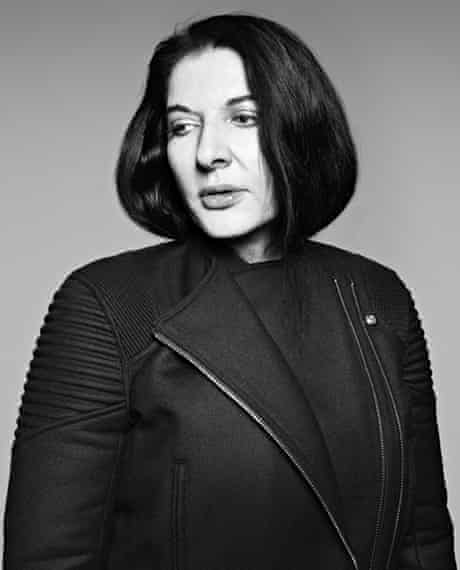
Incredibly, simply before she started the demonstration at MoMA, she began divorce proceedings from her then-husband, Paolo Canevari, the Italian artist. "At the end of the projection he came dorsum, for a year. Even more terrible. Zippo worked any more. It was – god – countless. But there is a part of you lot in these periods that is numb. You are totally blank."
Is she in a relationship at the moment?
"No. Of course, I dream to have this perfect man, who does not want to change me. And I'one thousand so not marriage material, it's terrible. Just my dream is to have those Sunday mornings, where you're eating breakfast and reading newspapers with somebody. I'thousand then old fashioned in real life, and I'm so not old fashioned in art. Simply I believe in true love, so perchance it will happen. Correct at present, no, I have no space. But life has been practiced to me. Lots of pain. Only it's OK."
It is an intensely weird way to live and she knows it. How things will piece of work out at the Serpentine, she doesn't know. British people are so inhibited, she says, and too inclined to ridicule. She is perhaps remembering what happened to David Blaine when he suspended himself in a Perspex box above the Thames all those years ago and was rewarded with jeers and people chucking bottles. But Abramović does non belong in his corny showbiz category. There is no illusion in what she does; when she cuts herself, information technology'southward existent. The whole point is information technology's real.
Anyhow, she says, "working with the British public is particularly difficult. They're very sarcastic. They're easily bored. They don't want to be involved in annihilation that might embarrass them, or brand fun of them. And that'due south a huge claiming." She is nervous as hell.
She is also looking beyond August to September, when she volition stage another performance slice at Sean Kelly Gallery, her professional person dwelling in New York and beyond that to her 70th birthday party, which the Guggenheim has offered to host. "I'm really a warrior of art," she says, the kind of phrase only a woman with Abramović'south background tin get away with. "When I practise things I do them properly, and then the other Marina comes and is very fragile and very vain and wants to eat ice-foam."
Or to put it another way, she says, "I love bad jokes. I dearest to enjoy everything. Then comes this moment to work – and it becomes a question of life or death."
Marina Abramović: 512 Hours is at The Serpentine Gallery, London W2, from 11 June to 25 August.
fawcettoncoure1975.blogspot.com
Source: https://www.theguardian.com/artanddesign/2014/may/12/marina-abramovic-ready-to-die-serpentine-gallery-512-hours
0 Response to "Woman Who Let People Do Whatever They Wanted for Art"
Post a Comment