What Is the Battery Life of the Nikon D7100 if You Review Photos
Introduction
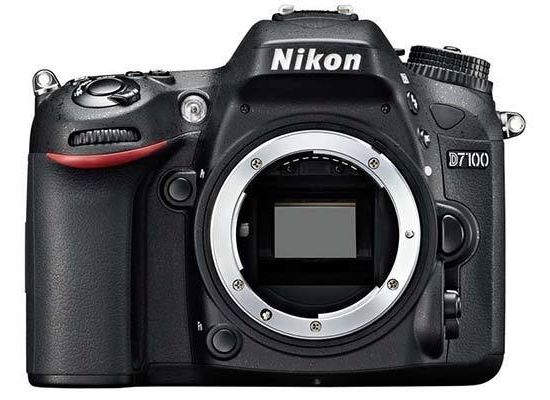
The Nikon D7100 is a new prosumer DSLR camera with a 24.1-megapixel DX-format image sensor and no optical low-laissez passer filter. Central highlights of the fully weather-sealed D7100 include Full 1080p movies upwards to 60i/50i and 30p/25p/24p with total-time autofocus and manual exposure control, an ISO range of 100-25600, a 2,016-pixel 3D Color Matrix metering organisation, EXPEED 3 image-processing engine, 51-signal Car-focus organisation of which 15 are cross-type, 14-bit analogue-to-digital conversion, 6fps continuous shooting, 1.3x crop office, dust- and wet-sealed magnesium alloy body, 1229k dot iii.two-inch LCD screen, and dual retention carte slots. The Nikon D7100 costs £1099.99/ $1199.95 / €1329.00 for body only and £1299.99 / $1599.95 / €1579.00 for the body and the AF-Due south DX Zoom-Nikkor 18-105mm f/3.v-v.6G ED VR kit lens.
Ease of Use
The new Nikon D7100 is externally very similar to the D7000, and so a lot of the comments that we fabricated in our review of that camera utilise as to the D7100. The Nikon D7100 slots in below the existing D600 and above the D7000 models - note that it isn't really replacing the D7000 (still) in the Nikon DSLR lineup.
The Nikon D7100 continues to ship with the 18-105mm f/3.5-5.6G ED VR kit lens, which feels well-balanced on the Nikon D7100 and despite simply having a plastic mount it fits into place with a reassuring mechanical click. It also adds the very important advantage of Vibration Reduction. Nikon bodies don't offering any grade of in-camera epitome stabilisation, unlike similar models from Sony, Pentax and Olympus, so the relatively affordable and versatile xviii-105mm VR lens is a good starting point if you don't already have any Nikon lenses.
The shutter release action on the Nikon D7100 is surprisingly tranquillity, with an exemplary dampened mirror slap that makes this DSLR actually quieter than some rangefinder cameras, and information technology'south tested for 150,000 cycles. Furthermore, in that location is as well a Placidity style, in which the mirror is raised fairly slowly to further reduce the sound it makes. This, nevertheless, introduces some shutter lag, which usually isn't worth the few decibels of difference versus what is already an impressively quiet shutter (Nikon actually recommends using the Quiet mode for taking pictures of sleeping babies, a state of affairs in which a chip of shutter delay obviously isn't a problem).
The overall control layout and 'philosophy' of the Nikon D7100 is very similar to the D7100, with two control wheels and dedicated buttons for controlling ISO sensitivity, white balance, metering and AF mode, and a lockable drive mode dial. The latter is somewhat awkward, requiring the use of both fore- and middle fingers. In improver the Playback button has is positioned to the left of the viewfinder in line with models higher up the range.
In that location are a few other interface changes as well, most notably the addition of a customisable "i" button and the swapping of the Zoom In and Zoom Out buttons on the rear. The D7000'south Alive View lever has given way to a button encircled past a switch that toggles between Photograph Live View and Flick Alive View modes, while the carmine movie record push button has been moved to the camera'due south top plate, close to the shutter release - but overall, the Nikon D7100'southward user interface has remained remarkably like to that of its predecessor.
The D7100 uses the aforementioned EN-EL15 battery and MH-25 recharger every bit the D7000, merely has a new battery grip, the MB-D15 Multi Battery Ability Pack. It records images on SD/SDHC/SDXC cards via non ane but two slots housed in the large right-hand compartment. This allows y'all to use two cards in tandem, with the ability to overflow images onto the second card, backup images from the first to the second, or save RAW to slot ane and JPEG to slot two. Information technology besides evidently greatly expands the overall memory chapters, useful if y'all shoot a lot of images in a short infinite of time.
The Nikon D7100 follows conventional DSLR design in having a shooting fashion punch on the meridian of the camera, now with useful lock button in the centre, which allows y'all to select either i of the advanced modes like Manual, Discontinuity- or Shutter-priority, or xix different scene modes. The new Effects shooting style provides provide 7 different filters that can be applied to both still images and movies. The Night Vision effect is peculiarly worth of mention, pushing the photographic camera's sensitivity to a whopping ISO 102,400, although a monochrome rather than colour image is recorded.
The Exposure Compensation push button is thoughtfully positioned adjacent to the shutter release. Concord downward this button with your right forefinger and spin the command wheel on the top-rear of the camera with your thumb to adjust its settings - uncomplicated and intuitive. The other buttons sitting next to the shutter release are the aforementioned Movie Record button and one for setting the metering. The D7100 has a similar monochromatic status LCD to the D90, a pro-level feature that indicates who this camera is primarily targeted at. On cheaper cameras, the LCD on the rear usually has to do both jobs, but on this model near of the key settings are visible from above on the smaller panel. This tin make the Nikon D7100 quicker to use and it may also extend the battery life, depending on how extensively yous use the rear LCD screen.
The D7000's 16.2 megapixel CMOS sensor has been superseded by a 24.i megapixel CMOS chip, capable of providing a Live View feed, recording Full HD video and capturing full-resolution stills at 6 frames per 2nd for upwards to 33 Fine JPEG images and vi fourteen-bit RAW images, slightly more than the D7000 for JPEG but significantly less for RAW. There's also a slightly faster charge per unit of 7fps in the new "i.3x" crop mode with an increased buffer of 73 fine JPEGs or 12 RAW files. The 1.3x crop function principally provides an additional i.3x telephoto effect. As the Nikon D7100 is a DX camera with a "ingather gene" of 1.5, the "one.3x" mode is in fact a 2x crop mode relative to 35mm full frame, essentially turning the Nikon D7100 into a fifteen-megapixel FourThirds photographic camera while retaining the 3:2 attribute ratio. In this mode the photographic camera's 51 focus points comprehend an even wider expanse of the frame for even better discipline acquisition. It also allows for faster operation of upwardly to 7 fps continuous shooting and Full Hard disk drive film recording up to 50i/60i.
The sensor tin can clean itself by mode of loftier-frequency vibrations that volition, at to the lowest degree in theory, milk shake off whatsoever not-adhesive grit particles that may have settled on it during a lens change. Y'all can specify, via an selection in the Setup menu, whether yous want sensor cleaning to have place at shutdown, startup, both or neither, with the default being 'both'. The cleaning process pleasingly has no applied touch on startup times, which were nigh instant. The new image sensor is complemented by the more powerful EXPEED 3 processing engine.
 |  |
| Pop-upwardly Flash | Top |
The D7100 upgrades its predecessors excellent three-inch, 920,000-dot monitor with a bigger and fifty-fifty higher-resolution 3.2 inch screen that has 1229k dots. The screen is used not only to navigate menus and to review pictures, but tin also act every bit a secondary status display, facilitating the transition for upgraders from entry-level DSLR owners who are not used to having a acme-mounted condition LCD on their cameras. It's as well the rear screen that provides live view for capturing both stills and movies. For this reason, we were a picayune disappointed that the monitor is still fixed, lacking articulation of any kind, something that 1 of the D7100's central rivals, the Catechism EOS 60D, does offer.
You still get a true optical TTL finder as well though, and information technology'due south an excellent one to kick, offering an impressive 100% frame coverage, 0.94x magnification and 170 degree viewing angle. The auto-focus system has also been significantly upgraded to the aforementioned 51-point system every bit the flagship Nikon D4 and the D800, with the centre point permanently marked on the focusing screen and the other 51 points lighting upwards as red boxes, and compositional filigree lines that can be called up via a menu option. 3 warning signs – reminding you that you are in black-and-white capture mode, the bombardment is running low or you have forgotten to insert a memory card – may too announced in the course of overlaid icons when appropriate. Below the finder is a traditional monochromatic condition bar that is the same equally the one seen in the D90.
The "info"button contributes greatly to the Nikon D7100's ease-of-use - pressing it displays most all of the camera's principal settings on the big rear screen. Then pressing the "i" button every bit the bottom of the vertical row of buttons to the left of the LCD screen allows you to interact with and set the onscreen options, with 10 available in total.
As stated above, the D7100 now has 51 motorcar-focus sensors, out of which 15 are a cantankerous type. The other 36 are of the line diversity, consequently being merely sensitive to either vertical or horizontal detail, but non both. In practice, this did not turn out to exist a problem, with the photographic camera typically locking focus on the subject easily, no matter which AF point was selected. Be aware though that the default AF area manner is 'car-area' in most of the scene and exposure modes, including P, A, S and M too. In automobile-expanse way it is the camera, rather than the photographer, that chooses which AF bespeak(south) to use, which is ordinarily non desirable. You can alter this to single-point, dynamic-expanse or 3D-tracking AF. Single-point AF is what you lot will want to use most of the fourth dimension, every bit it gives you the opportunity to specify which of the 51 automobile-focus sensors should be engaged. In the viewfinder, the agile AF point appears as a red square, which is easy to encounter. Selecting the active AF signal is done by holding down the Af manner push and using the iv-mode pad, unless the focus selector lock is in the L (=Locked) position.
If you select dynamic-area AF, you can as well specify an AF point, just the photographic camera 'will focus based on information from surrounding focus points if subject briefly leaves selected bespeak', as the user guide puts it. This is the default AF area mode in the Sports scene mode. More interesting is the 3D focus tracking characteristic. Basically this lets you specify the focus point that is right on your subject, then the camera volition attempt to runway this bailiwick as it moves across the frame, using whichever AF point it deems appropriate in any given moment. Apparently, the photographic camera does this using color information from the ii,016-segment RGB metering sensor to identify the subject. In the field, it was quite astounding to see 3D focus tracking in activity.
The modus operandi of the auto-focus system can also be specified by the photographer. In that location is zilch new hither: AF-Southward is for stationary subjects – an AF assistance lamp is available for utilize at close range in low calorie-free – AF-C is for moving ones, while AF-A is the all-time of both worlds. Cycling through these modes is washed past holding downwardly the dedicated AF button on the left-side of the camera, and turning a control wheel. Annotation that some of the AF expanse modes, namely dynamic area and 3D focus tracking, will only work the way described above if you are either in AF-A or AF-C. The camera besides allows you to focus on your subject manually. To do this, turn the AF/MF switch, found below the lens release button, to the position marked with an 'M', and use the MF ring on the lens to focus.
Ane area of photography that the D7100 is peculiarly well suited to is flash photography. The camera has a built-in speedlight with a guide number of 12 (in metres) at ISO 100. In auto mode, this wink will pop-up automatically if the camera thinks information technology's necessary, but in most other exposure modes, it is left to the lensman to decide whether to use it or non. This little flash can non only be used as an emergency light source or a fill calorie-free, but also as a commander for up to ii groups of wireless flash units. In such a setup, you can specify if you want the on-lath wink to give only a point to fire off the wireless slaves or besides to provide some fill light. It is also possible to chose the mode of performance (TTL, Auto or Manual) for 1 or both of the slaved wink groups, and even to regulate their output from the camera. Compatible flashguns include the SB-900, SB-800, SB-700, SB-600, and SB-400 wink units.
Equally with most contempo DSLR cameras from both Nikon and the other manufacturers, the D7100 offers Alive View off the main sensor. The D7000'south Alive View lever has given fashion to a push button encircled by a switch that toggles between Photo Live View and Movie Live View modes. In Photo Live View mode, printing the button and the mirror flips upward, the shutter opens and the rear screen displays the scene as seen through the lens. Live View is either delivered on the high-resolution rear monitor or on whatever LCD panel or plasma screen connected to the camera via an HDMI cablevision. In that location is a red rectangle in the heart for focusing , which you can move practically anywhere in the frame. When in transmission focus mode, you lot can magnify into this rectangle in five steps only by repeatedly pressing the button marked with a loupe icon, only this magnification seems to be interpolated rather than existent. This means that you cannot run across particular down to the pixel level, unlike with many competing cameras, which is a disappointment given the excellent LCD screen.
Manual Focus is non the only focusing option in Alive View when taking still images. The D7100 has two AF modes in Alive View, AF-A and AF-F. Both utilize a dissimilarity-detect method of focusing, with AF-A locking onto the subject when you lot one-half-press the shutter push, and AF-F (full-fourth dimension-servo AF) automatically tracking the subject continuously even if it moves. The D7100'south Alive View auto-focusing isn't very fast, typically taking between 1 and ii seconds to lock focus on a bailiwick in good light, and even longer in low-light conditions. There are selectable AF-area modes according to the subject; face-priority AF, wide-area AF, normal-expanse AF and subject-tracking AF. 'Face-Priority AF' had no trouble finding and keeping track of human faces every bit long as they were facing the camera, and the organisation can notice up to 35 faces and volition attempt to focus on the one closest to the photographic camera.
The amount of overlaid information is user selectable, and tin include a shooting grid similar to what you lot tin can see in the optical viewfinder and also the virtual horizon which helps to keep your images straight. This feature can also be turned on and off via the reprogrammable Fn button, which can be assigned to a range of unlike functions, and also appears in the optical viewfinder status bar via the exposure compensation scale. But there'due south still no live histogram, equally on the D90, which is a glaring omission that makes Live View much less usable than it could be, and once more puts Nikon behind the competition in this expanse. Photographers who intend to apply Live View mainly for tripod work will, on the other hand, be delighted to larn that the camera offers true mirror lock up.
Live View is likewise employed by the Nikon D7100'southward motion-picture show manner. After moving the Lv switch to the Movie Alive View position and optionally presetting the aperture, shutter speed and focus, you can start recording video past pressing the Movie push with the ruddy dot sitting inside the Lv switch. The camera records full loftier-definition, wide-screen video in 1920x1280 pixel resolution, at a frame charge per unit of 60i/50i in the 1.3x crop mode and 30p/25p/24p in the DX format,both in AVI format using the move JPEG codec. As with Live View, dissimilarity-detect AF is possible whilst shooting movies, although every bit with nevertheless images there's an audible whine every bit the camera refocuses and it'due south still too slow to focus on any fast-moving subject area, so much so that we doubtable most serious users will utilise manual focusing instead.
You lot tin can set both the aperture and the shutter speed from the camera in movie fashion, although the slowest shutter speed is limited to 1/30th second, plus exposure compensation and AE-Lock can also exist set. Out of the box the D7100 can now tape stereo sound via its built-in microphone with three different levels of sensitivity on offer, and stereo recording tin be recorded using an optional external microphone. The maximum size of a single video prune is 2 gigabytes which, given that movies occupy about 100 megabytes of storage infinite per minute, would theoretically translate into virtually 20 minutes of continuous recording, but – plainly because of certain legal regulations in the European union –, Nikon decided to limit the clip length to 5 minutes for high-definition movies.
For the images already captured, the Nikon D7100 offers a wide range of retouching tools, including mail service-capture D-lighting (useful if you forgot to turn on Active D-lighting earlier capture), red-eye correction, trimming, monochrome conversion, unlike filter furnishings, color adjustments, image resizing, image overlay, in-camera raw processing, quick auto retouching, straightening of kleptomaniacal pictures, lens distortion correction, perspective control (reduction of keystoning), and fisheye, miniature, colour outline and colour sketch effects. Many of these functions make information technology unnecessary to buy specialised calculator programs or plug-ins and spend hours in front of a computer to achieve a desired/popular effect. Interval timer shooting is a powerful feature and something that isn't offered by the older D90.
As far every bit connectivity goes, there are USB / VideoOut and HDMI ports as well equally accessory terminals for the connectedness of an external microphone and either wired remote or a GPS unit, and a new headphone jack for monitoring audio while you lot shoot, all sheltered backside iii rubberised doors on the left side of the camera, when viewed from the dorsum.
Image Quality
All of the sample images in this review were taken using the 24.1 megapixel Fine JPEG setting, which gives an average prototype size of around 10Mb.
The Nikon D7100 produced images of outstanding quality during the review menses. The D7100 produces racket-gratuitous JPEG images at ISO 100-1600, with ISO 3200 likewise looking pretty practiced. ISO 6400 merely shows a fiddling racket, while the fastest settings of ISO 12800 and 25600 are quite a lot noisier and suffer from softening of fine detail and a loss of saturation, but the images are withal perfectly usable for small prints and resizing for web use. The images were a little soft straight out of the D7100 at the default sharpening setting and ideally crave some further sharpening in an application like Adobe Photoshop, or you can alter the in-camera setting for JPEG files. The dark photo was excellent, with the maximum shutter speed of thirty seconds and bulb mode allowing you to capture plenty of light. Ruby-red-eye was not a mutual occurrence with the built-in flash, and when nosotros did run across information technology, it was very moderate and easily cured by setting the wink to red-eye reduction mode. Active D-lighting managed to squeeze near of the dynamic range captured past the sensor into the JPEGs the photographic camera produced.
Dissonance
There are ix ISO settings bachelor on the Nikon D7100 and the ISO speed can be adjusted in ane/iii EV increments. Hither are some 100% crops which evidence the noise levels for each ISO setting, with JPEG on the left and RAW on the right.
The Nikon D7100 also has ISO Sensitivity Auto Control, activated from the shooting bill of fare. If fix to On, the camera will automatically conform the sensitivity if proper exposure cannot be achieved at the value called by the photographer. The user can put a limit on the maximum sensitivity selectable past the photographic camera.
| JPEG | RAW |
| ISO 100 (100% Crop) | ISO 100 (100% Crop) |
 |  |
| ISO 200 (100% Crop) | ISO 200 (100% Crop) |
 |  |
| ISO 400 (100% Crop) | ISO 400 (100% Crop) |
 |  |
| ISO 800 (100% Crop) | ISO 800 (100% Crop) |
 |  |
| ISO 1600 (100% Crop) | ISO 1600 (100% Crop) |
 |  |
| ISO 3200 (100% Crop) | ISO 3200 (100% Crop) |
 |  |
| ISO 6400 (100% Crop) | ISO 6400 (100% Crop) |
 |  |
| ISO 12800 (100% Ingather) | ISO 12800 (100% Ingather) |
 |  |
| ISO 256 00 (100% Crop) | ISO 25600 (100% Crop) |
 |  |
File Quality
The file quality settings available on the D7100 include Bones, Normal and Fine for JPEGs, plus you can also store your photos in Nikon's proprietary raw format (NEF). Here are some 100% crops which evidence the quality of the various options, with the file size shown in brackets.
| Fine (10.2Mb) (100% Crop) | Normal (6.95Mb) (100% Crop) |
 |  |
| Basic (3.81Mb) (100% Crop) | RAW (27.8Mb) (100% Crop) |
 |  |
Sharpening
Here are 2 100% crops which accept been Saved as Web - Quality l in Photoshop. The correct-mitt image has had some sharpening applied in Photoshop. The out-of-the camera images are a little soft at the default sharpening setting and benefit from some farther sharpening in a program like Adobe Photoshop. You lot tin can also change the in-camera sharpening level to adapt your tastes by irresolute the Motion picture Styles.
| Original (100% Crop) | Sharpened (100% Crop) |
 |  |
 |  |
Flash
The pop-up flash on the D7100 has several settings including Machine, Fill-in flash, Red-eye Reduction, SlowSync, Crimson-middle Reduction with Ho-hum Sync, Rear-curtain Sync and Off. The mode of operation can be TTL, Motorcar or Manual, and there is Flash Exposure Compensation (FEC) available as well. These pictures of a white wall were taken at a altitude of 1.5m using the kit zoom.
| Flash Off - Wide Angle (27mm) | Flash On - Wide Angle (27mm) |
 |  |
| Flash Off - Telephoto (157.5mm) | Flash On - Telephoto (157.5mm) |
 |  |
And here are a couple of portrait shots. Neither the flash on or the cerise-heart reduction mode casused whatsoever amount of blood-red-eye.
| Flash On | Wink On (100% Crop) |
 |  |
| Red-eye Reduction | Red-eye Reduction (100% Crop) |
 |  |
Night
The Nikon D7100 lets yous punch in shutter speeds of up to thirty seconds and has a Bulb mode equally well for exposure times of practically any length, which is very practiced news if y'all are seriously interested in night photography. At that place is an optional long-exposure noise reduction part that can be activated to filter out whatsoever hot pixels that may announced when extremely irksome shutter speeds are used. Do note that this works by way of dark frame subtraction, which effectively doubles the exposure time. The shot below was taken using a shutter speed of 25 seconds, aperture of f/8 at ISO 100. We've included a 100% crop for you to see what the quality is similar.
| Night | Dark (100% Crop) |
 |  |
Image Stabilisation
The Nikon D7100 does not offer body-integral image stabilisation, merely the 18-105mm kit lens bundled with the photographic camera features Vibration Reduction, Nikon's proprietary lens-based optical stabilisation system. This allows y'all to have sharp mitt-held photos at slower shutter speeds than with lenses that lack this office. To illustrate this, nosotros took 2 photos at the brusk and long end of the zoom, with VR turned on and off.
| Shutter Speed / Focal Length | Epitome Stabilisation Off (100% Crop) | Epitome Stabilisation On (100% Crop) |
| 1/six sec / 27mm |  |  |
| 1/6 sec / 157.5mm |  |  |
HDR
The Nikon D7100 has a HDR manner with four levels of manual exposure and an Auto setting. The photographic camera merely combines two shots, one nether and one over exposed, to produce the concluding prototype, and it'southward only available when shooting JPEGs.
| HDR - Off | HDR - Depression |
 |  |
| HDR - Normal | HDR - High |
 |  |
| HDR - Extra Loftier | |
 |
D-lighting
D-lighting is Nikon's dynamic range optimisation tool that attempts to squeeze the full dynamic range of the sensor into JPEGs. The available settings are Off, Low, Medium, High, Actress High and Machine. The post-obit examples demonstrate the differences between the diverse settings.
| D-lighting Off | D-lighting Depression |
 |  |
| D-lighting Normal | D-lighting Loftier |
 |  |
| D-lighting Extra High | |
 |
Picture show Controls
Nikon's Picture Controls are alike to Canon's Picture Styles in being preset combinations of sharpening, contrast, brightness, saturation and hue. The available choices are Standard, Neutral, Vivid, Monochrome, Portrait and Mural. The following examples demonstrate the differences across these options.
| Standard | Neutral |
 |  |
| Bright | Monochrome |
 |  |
| Portrait | Landscape |
 |  |
Furnishings
The Effects shooting mode provides 7 different artistic filters that tin be applied to both still images and movies.
| Colour Sketch | Miniature Outcome |
 |  |
| Selective Color | Silhouette |
 |  |
| High Primal | Low Cardinal |
 |  |
| Nighttime Vision | |
 |
Sample Images
This is a pick of sample images from the Nikon D7100 photographic camera, which were all taken using the 24.1 megapixel Fine JPEG setting. The thumbnails below link to the full-sized versions, which have not been contradistinct in any way.
Sample RAW Images
The Nikon D7100 enables users to capture RAW and JPEG format files. We've provided some Nikon RAW (NEF) samples for you to download (thumbnail images shown below are not 100% representative).
Sample Movie & Video
This is a sample movie at the highest quality setting of 1920x1280 pixels at 30 frames per second. Delight annotation that this 24 second movie is 68.3Mb in size.
Product Images
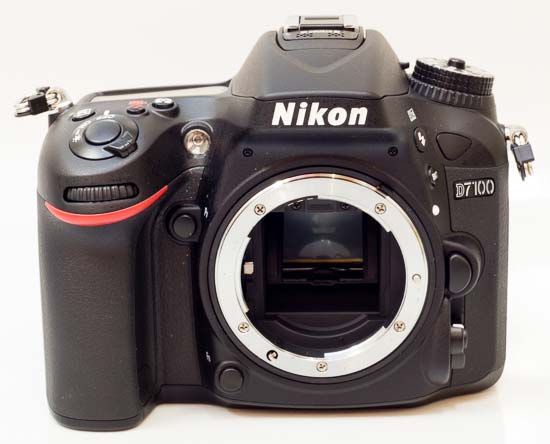 |
| Front of the Photographic camera |
 |
| Forepart of the Camera |
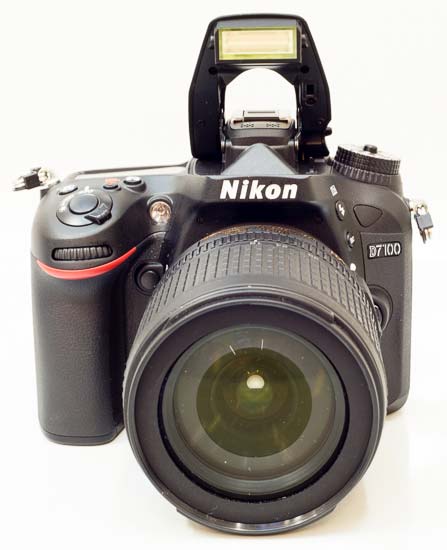 |
| Front of the Photographic camera / Pop-upwardly Flash |
 |
| Isometric View |
 |
| Isometric View |
 |
| Isometric View |
 |
| Isometric View |
 |
| Rear of the Photographic camera |
 |
| Rear of the Camera / Image Displayed |
 |
| Rear of the Camera / Turned On |
 |
| Rear of the Camera / Info Screen |
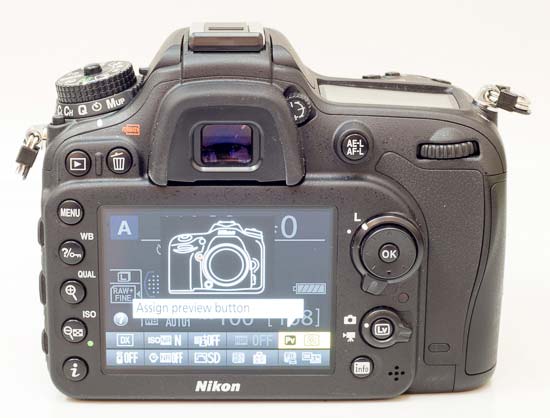 |
| Rear of the Camera / Info Screen |
 |
| Rear of the Camera / Playback Menu |
 |
| Rear of the Photographic camera / Shooting Menu |
 |
| Rear of the Photographic camera / Custom Setting Menu |
 |
| Rear of the Camera / Setup Menu |
 |
| Rear of the Camera / Retouch Card |
 |
| Rear of the Camera / Recent Settings Menu |
 |
| Tiptop of the Camera |
 |
| Bottom of the Camera |
 |
| Side of the Camera |
 |
| Side of the Photographic camera |
 |
| Front of the Camera |
 |
| Front of the Camera |
 |
| Memory Card Slot |
 |
| Battery Compartment |
Decision
The new Nikon D7100 builds on the considerable success of the two 1/2 year old D7000 camera principally by significantly increasing the image resolution whilst maintaining outstanding quality for a DX sensor, implementing the aforementioned cutting-edge 51-bespeak autofocus organisation every bit the flagship D4 pro DSLR, incorporating the same level of weather sealing as the D800, and debuting the the innovative ane.3x ingather way. At first glance it may seem like a modest upgrade of a camera that was ahead of its time, but there are a whole raft of major and minor improvements that add up to make this the one of the best Nikon DX cameras and a worthy successor to the D7000 (which is notwithstanding considered good enough to remain in the Nikon range).
The D7100'southward 24.1 megapixel sensor makes it the highest-resolution Nikon DX DSLR, and thankfully that hasn't come up at the price of detracting from the image quality, which is first-class. There's virtually no noise from the base sensitivity of ISO 100 all the way upward to 3200, with the higher settings of 6400, 12,800 and even to a lesser extent 25,600 all perfectly usable for smaller prints - very impressive for a one.5x sensor. Exposure, color and white balance were all uniformly reliable, with the selection of the RAW format if yous want to take command. But the lack of whatever control over noise reduction using the ViewNX 2 RAW editing software supplied in the box detracts slightly from an otherwise impeccable functioning.
In addition to the 51-point AF system, the 1.3x crop mode is the most surprising addition to the D7100, not only increasing the reach of all your lenses, simply also widening the autofocus coverage, increasing the burst shooting speed and buffer depth, and allowing 60i/50i movies to be recorded. All good news for sports and wildlife photographers who perhaps don't necessarily demand the full 24 megapixel resolution.
Videographers are nevertheless well-catered for, with the new headphone jack and stereo sound in particular improving this area of functioning. Nosotros'd withal liked to have seen an articulating screen though - you'll demand to consider the cheaper D5200 (or the Catechism EOS 60D) if this is 1 of your must-have features - and the D7100's contrast AF organisation is notwithstanding too slow to proceed up with fast-moving subjects, accompanied by an annoying whine that's audible in the video. Offering GPS and Wi-fi connectivity via optional accessories increases the potential flexibility of the D7100, but some rivals such as the Canon EOS 6D now more than conveniently feature born wireless.
In summary the new Nikon D7100 further improves on the already excellent D7000 in several key means and many minor ones, all adding upwardly to make this the best DX-format DSLR to appointment. Nikon may be focusing on a total-frame futurity, but the D7100 clearly shows that they oasis't forgotten the cropped sensor market place. It may look about identical to its predecessor, just the Nikon D7100 certainly proves that start impressions can be very deceiving...
| Ratings (out of 5) | |
|---|---|
| Blueprint | 4.5 |
| Features | four.v |
| Ease-of-use | 4.5 |
| Paradigm quality | five |
| Value for coin | 4.5 |
Review Roundup
Reviews of the Nikon D7100 from around the web.
Iii years agone Nikon announced the Nikon D7000 DSLR, a camera many probably weren't expecting. With the Nikon D90, Nikon D300 and Nikon D300S models already available, it didn't appear equally through in that location would be much demand for a farther line of models betwixt the ii. Yet, the camera gained much popularity thanks to its high features-to-grade ratio, and provided a logical stepping rock for accomplished entry-level DSLR owners looking to have their photography more seriously. And at present, Nikon has gathered together some of the features seen in its about recent DSLRs and composite them with a scattering of new ones to create the Nikon D7100 successor.
Read the total review »
Cameras are evolving. The Nikon D7100 is testament to that - it non merely employs plenty top specs to rival even the well-established D300S from Nikon'southward own range but, and much similar the Nikon D800E, has removed the low-pass filter from its imaging equation. This trick - if information technology tin can exist called that - cuts out diffusion that said filter would otherwise serve to function and, therefore, images should have improved sharpness direct from camera.
Read the total review »
Specifications
| Type | Single-lens reflex digital camera |
| Lens mount | Nikon F mount (with AF coupling and AF contacts) |
| Effective angle of view | Nikon DX format; focal length in 35 mm [135] format equivalent to approx. 1.5x that of lenses with FX format angle of view |
| Constructive pixels | 24.1 million |
| Image sensor | 23.v x xv.6 mm CMOS sensor |
| Total pixels | 24.71 million |
| Dust-reduction Organization | Image sensor cleaning, Image Dust Off reference data (optional Capture NX 2 software required) |
| Storage - Image size (pixels) | DX (24 10 xvi) prototype expanse: 6000 10 4000 (L), 4496 x 3000 (K), 2992 x 2000 (S); 1.3x (18 ten 12) image area: 4800 x 3200 (Fifty), 3600 x 2400 (One thousand), 2400 x 1600 (S); Photographs with paradigm surface area of DX (24 x 16) taken in movie live view: 6000 x 3368 (L), 4494 10 2528 (M), 2992 x 1860 (S); Photographs with image expanse of ane.3x (xviii ten 12) taken in movie live view: 4800 x 2696 (Fifty), 3600 x 2024 (K), 2400 ten 1344 (S); |
| File format | NEF (RAW): 12 or fourteen fleck, lossless compressed or compressed; JPEG: JPEG-Baseline compliant with fine (approx. 1 : 4), normal (approx. 1 : 8), or basic (approx. one : 16) compression (Size priority); Optimal quality compression available; NEF (RAW) + JPEG: Single photograph recorded in both NEF (RAW) and JPEG formats |
| Moving-picture show Control Arrangement | Standard, Neutral, Bright, Monochrome, Portrait, Landscape; selected Movie Control tin can be modified; storage for custom Picture Controls |
| Media | SD (Secure Digital) and UHS-I compliant SDHC and SDXC memory cards |
| Double slot | Slot 2 can exist used for overflow or fill-in storage or for separate storage of copies created using NEF+JPEG; pictures can exist copied betwixt cards. |
| File system | DCF (Blueprint Rule for Camera File System) 2.0, DPOF (Digital Impress Lodge Format), Exif (Exchangeable Epitome File Format for Digital Nevertheless Cameras) 2.3, PictBridge |
| Viewfinder | Center-level pentaprism unmarried-lens reflex viewfinder |
| Frame coverage | Approx. 100% horizontal and 100% vertical |
| Magnification | Approx. 0.94x (50 mm f/i.iv lens at infinity, -ane.0 thou-ane) |
| Eyepoint | xix.5 mm (-1.0 m-1; from center surface of viewfinder eyepiece lens) |
| Diopter adjustment | -2 - +i m-ane |
| Focusing screen | Blazon B BriteView Articulate Matte Mark II screen with AF area brackets (framing grid tin be displayed) |
| Reflex mirror | Quick return |
| Depth-of-field preview | Pressing depth-of-field preview button stops lens aperture down to value selected by user (A and M modes) or past camera (other modes) |
| Lens aperture | Instant return, electronically controlled |
| Uniform lenses | Compatible with AF NIKKOR lenses, including type G and D lenses (some restrictions utilize to PC lenses) and DX lenses, AI-P NIKKOR lenses, and non-CPU AI lenses (A and Yard modes simply). IX NIKKOR lenses, lenses for the F3AF, and non-AI lenses tin not be used. The electronic rangefinder can be used with lenses that have a maximum aperture of f/5.6 or faster (the electronic rangefinder supports the heart focus bespeak with lenses that have a maximum aperture of f/8 or faster). |
| Shutter type | Electronically-controlled vertical-travel focal-airplane shutter |
| Shutter speed | 1/8000 - 30 s in steps of ane/3 or 1/2 EV, bulb, time, X250 |
| Flash sync speed | X=ane/250 s; synchronizes with shutter at 1/320 s or slower (flash range drops at speeds between i/250 and 1/320 southward) |
| Release mode | Single frame (Due south), continuous depression speed (CL), continuous loftier speed (CH), quiet shutter-release (Q), self-timer, mirror upwards (MUP); interval timer photography supported |
| Estimate frame advance charge per unit | JPEG and 12-fleck NEF (RAW) images recorded with DX (24 10 sixteen) selected for Paradigm area CL: 1 - 6 fps, CH: half dozen fps JPEG and 12-bit NEF (RAW) images recorded with 1.3x (18 x 12) selected for Image area CL: one - 6 fps, CH: 7 fps xiv-bit NEF (RAW) images recorded with DX (24 ten 16) selected for Prototype area CL: 1 - 5 fps, CH: 5 fps 14-bit NEF (RAW) images recorded with 1.3x (18 x 12) selected for Image area CL: 1 - 6 fps, CH: vi fps |
| Cocky-timer | 2 s, v s, ten s, 20 due south; i - 9 exposures at intervals of 0.5, 1, 2, or 3 s |
| Remote command modes (ML-L3) | Delayed remote, quick-response remote, remote mirror-upwards |
| Exposure - Metering mode | TTL exposure metering using 2016-pixel RGB sensor |
| Exposure - Metering method | Matrix: 3D color matrix metering II (type G and D lenses); colour matrix metering 2 (other CPU lenses); colour matrix metering available with non-CPU lenses if user provides lens data Center-weighted: Weight of 75% given to viii mm circle in centre of frame. Diameter of circle tin be changed to 6, 10, or 13 mm, or weighting can be based on average of entire frame (non-CPU lenses use 8-mm circle) Spot: Meters 3.5 mm circle (near two.5% of frame) centered on selected focus betoken (on center focus point when non-CPU lens is used) |
| Exposure - Range (ISO 100, f/1.4 lens, 20 °C/68 °F) | Matrix or center-weighted metering: 0 - 20 EV Spot metering: ii - twenty EV |
| Exposure meter coupling | Combined CPU and AI |
| Exposure – Manner | Car modes (auto; auto (flash off)); programmed auto with flexible program (P); shutter-priority motorcar (S); aperture-priority machine (A); manual (M); scene modes (portrait; landscape; child; sports; close upwards; nighttime portrait; night landscape; political party/indoor; beach/snow; dusk; dusk/dawn; pet portrait; candlelight; flower; autumn colors; food); special effects modes (night vision; color sketch; miniature effect; selective color; silhouette; high cardinal; low key); U1 (user settings one); U2 (user settings 2) |
| Exposure bounty | Can exist adjusted past -5 - +five EV in increments of 1/3 or one/2 EV in P, Southward, A, and One thousand modes |
| Exposure bracketing | 2 - 5 frames in steps of 1/3, i/ii, ii/3, 1, 2, or 3 EV |
| Flash bracketing | 2 - 5 frames in steps of 1/three, 1/2, 2/three, i, 2, or three EV |
| White residuum bracketing | 2 - 5 frames in steps of 1, ii, or 3 |
| ADL bracketing | 2 frames using selected value for one frame or 3 frames using preset values for all frames |
| Exposure lock | Luminosity locked at detected value with AE-L/AF-Fifty button |
| ISO sensitivity (Recommended Exposure Index) | ISO 100 - 6400 in steps of one/3 or 1/2 EV. Can also exist set to approx. 0.3, 0.v, 0.7, i, or 2 EV (ISO 25600 equivalent) higher up ISO 6400; motorcar ISO sensitivity command available |
| Active D-Lighting | Auto, Extra high, Loftier, Normal, Low, Off |
| Focus - Autofocus | Nikon Advanced Multi-CAM 3500DX autofocus sensor module with TTL phase detection, fine-tuning, 51 focus points (including xv cantankerous-blazon sensors; the eye focus point is bachelor at apertures slower than f/5.vi and faster than f/viii or at f/eight), and AF-assist illuminator (range approx. 0.5 - 3m/ane ft 8 in. - 9 ft 10 in.) |
| Focus - Detection range | -2 - +19 EV (ISO 100, 20 °C/68 °F) |
| Focus - Lens servo | Autofocus (AF): Single-servo AF (AF-South); continuous-servo AF (AF-C); automobile AF-Due south/AF-C selection (AF-A); predictive focus tracking activated automatically according to subject condition Manual focus (1000): Electronic rangefinder can exist used |
| Focus betoken | Can be selected from 51 or 11 focus points |
| AF-surface area mode | Unmarried-point AF; 9-, 21-, or 51-point dynamic-surface area AF, 3D-tracking, auto-area AF |
| Focus lock | Focus tin exist locked by pressing shutter-release button halfway (single-servo AF) or by pressing AE-L/AF-50 button |
| Flash - Built-in wink | Motorcar, portrait, kid, shut upwardly, night portrait, party/indoor, pet portrait, color sketch: Auto flash with car popular-up P, S, A, G, food: Transmission pop-up with button release |
| Wink - Guide Number | Approx. 12/39, 12/39 with manual wink (m/ft, ISO 100, 20 °C/68 °F) |
| Flash control | TTL: i-TTL flash control using 2016-pixel RGB sensor is available with built-in flash and SB-910, SB-900, SB-800, SB-700, SB-600, or SB-400; i-TTL counterbalanced fill-flash for digital SLR is used with matrix and center-weighted metering, standard i-TTL flash for digital SLR with spot metering |
| Flash way | Machine, automobile with red-eye reduction, auto slow sync, automobile slow sync with red-center reduction, fill-flash, blood-red-centre reduction, dull sync, slow sync with carmine-eye reduction, rear-drapery with tiresome sync, rear-curtain sync, off; Auto FP Loftier-Speed Sync supported |
| Flash compensation | -3 - +1 EV in increments of 1/3 or i/2 EV |
| Flash-fix indicator | Lights when congenital-in flash or optional flash unit of measurement is fully charged; flashes after flash is fired at full output |
| Flash - Accessory shoe | ISO 518 hot-shoe with sync and data contacts and safety lock |
| Nikon Artistic Lighting System (CLS) | Advanced Wireless Lighting supported with: - SB-910, SB-900, SB-800, or SB-700 equally a master wink and SB-600 or SB-R200 as remotes, or SU-800 as commander - Built-in flash can serve every bit master wink in commander mode. Motorcar FP High-Speed Sync and modeling illumination supported with all CLS-compatible wink units except SB-400; Flash Color Data Communication and FV lock supported with all CLS-compatible flash units |
| Flash - Sync terminal | AS-xv sync terminal adapter (available separately) |
| White balance | Auto (2 types), incandescent, fluorescent (7 types), direct sunlight, wink, cloudy, shade, preset manual (upward to 6 values can be stored, spot white balance measurement available during live view), choose colour temperature (2500 K - 10000 K), all with fine-tuning |
| Live View - Modes | Live view photography (still images), movie live view (movies) |
| Alive View - Lens servo | Autofocus (AF): Single-servo AF (AF-Due south); full-time-servo AF (AF-F) Manual focus (Grand) |
| Live View - AF-area way | Face-priority AF, wide-area AF, normal-area AF, discipline-tracking AF |
| Live View - Autofocus | Contrast-notice AF anywhere in frame (camera selects focus point automatically when face-priority AF or field of study-tracking AF is selected) |
| Motion picture - Metering | TTL exposure metering using main image sensor |
| Picture show - Metering method | Matrix |
| Movie - Frame size (pixels) and frame rate | 1920 x 1080; 60i (59.94 fields/s)/ 50i (50 fields/southward) * 1920 x 1080; thirty p (progressive), 25p, 24p 1280 10 720; 60p, 50p Actual frame rates for 60p, 50p, 30p, 25p, and 24p are 59.94, 50, 29.97, 25, and 23.976 fps respectively; options back up both high and normal prototype quality * Bachelor just when 1.3x (xviii x 12) is selected for Epitome area. Sensor output is most lx or 50 fps. |
| Video file format | MOV |
| Video pinch | H.264/MPEG-4 Advanced Video Coding |
| Sound recording format | Linear PCM |
| Sound recording device | Built-in or external stereo microphone; sensitivity adjustable |
| Monitor | eight-cm/3.2-in., approx. 1229 k-dot (VGA; 640 x 4 x 480 = 1,228,800 dots), TFT monitor with approx. 170° viewing bending, approx. 100% frame coverage, and effulgence adjustment |
| Playback | Full-frame and thumbnail (four, nine, or 72 images or calendar) playback with playback zoom, motion picture playback, photo and/or movie slide shows, histogram display, highlights, photo information, GPS information display, and auto image rotation |
| Interface - USB | Hi-Speed USB |
| HDMI output | HDMI mini connector (Blazon C) |
| Accessory last | Wireless remote controller: WR-one and WR-R10 (available separately) Remote cord: MC-DC2 (available separately) GPS unit of measurement: GP-1 (available separately) |
| Audio input | Stereo mini-pin jack (3.5 mm diameter; plug-in power supported) |
| Sound output | Stereo mini-pivot jack (iii.5 mm bore) |
| Supported languages | Arabic, Bengali, Chinese (Simplified and Traditional), Czech, Danish, Dutch, English language, Finnish, French, German, Greek, Hindi, Hungarian, Indonesian, Italian, Japanese, Korean, Norwegian, Farsi, Smoothen, Portuguese (European and Brazilian), Romanian, Russian, Castilian, Swedish, Tamil, Thai, Turkish, Ukrainian, Vietnamese |
| Power source - Battery | 1 rechargeable Li-ion EN-EL15 battery |
| Battery pack | Optional MB-D15 multi-power battery pack with one rechargeable Nikon EN-EL15 Li-ion bombardment or six AA alkaline, Ni-MH, or lithium batteries |
| Air conditioning adapter | EH-5b Air conditioning adapter; requires EP-5B power connector (available separately) |
| Tripod socket | 1/iv in. (ISO 1222) |
| Dimensions (Westward 10 H x D) | Approx. 135.5 ten 106.5 x 76 mm (5.3 x four.2 10 3.0 in.) |
| Weight | Approx. 765 g (1 lb 11.0 oz) with battery and retentivity bill of fare just without body cap; approx. 675 g (ane lb 7.eight oz; camera body only) |
| Operating environs - Temperature | 0 °C - 40 °C (+32 °F - 104 °F) |
| Operating environment - Humidity | 85% or less (no condensation) |
| Supplied accessories | EN-EL15 rechargeable Li-ion battery (with final comprehend), MH-25 battery charger, DK-five eyepiece cap, AN-DC1 strap, UC-E6 USB cable, BS-1 accompaniment shoe cover, DK-23 rubber eyecup, BF-1B body cap, ViewNX 2 CD, User's Manual |
Your Comments
- Introduction
- Ease of Apply
- Prototype Quality
- Sample Images
- Product Images
- Conclusion
- Review Roundup
- Specifications
fawcettoncoure1975.blogspot.com
Source: https://www.photographyblog.com/reviews/nikon_d7100_review
0 Response to "What Is the Battery Life of the Nikon D7100 if You Review Photos"
Post a Comment